
Late-Summer Kitchen Refresh: Small Updates, Big Impact Summer has a way of putting your kitchen…

How to Choose the Right Area Rug for Every Room
How to Choose the Right Area Rug for Every Room
Area rugs add warmth, personality, and comfort to a room in a way that’s hard to replicate with anything else. Sometimes a rug is interesting enough to anchor the entire design — we’ll start there and build the furniture, art, and accessories around it. Other times it plays a quieter role, a soft foundation that just ties everything together. Either way, getting the size right is everything.
Living Rooms
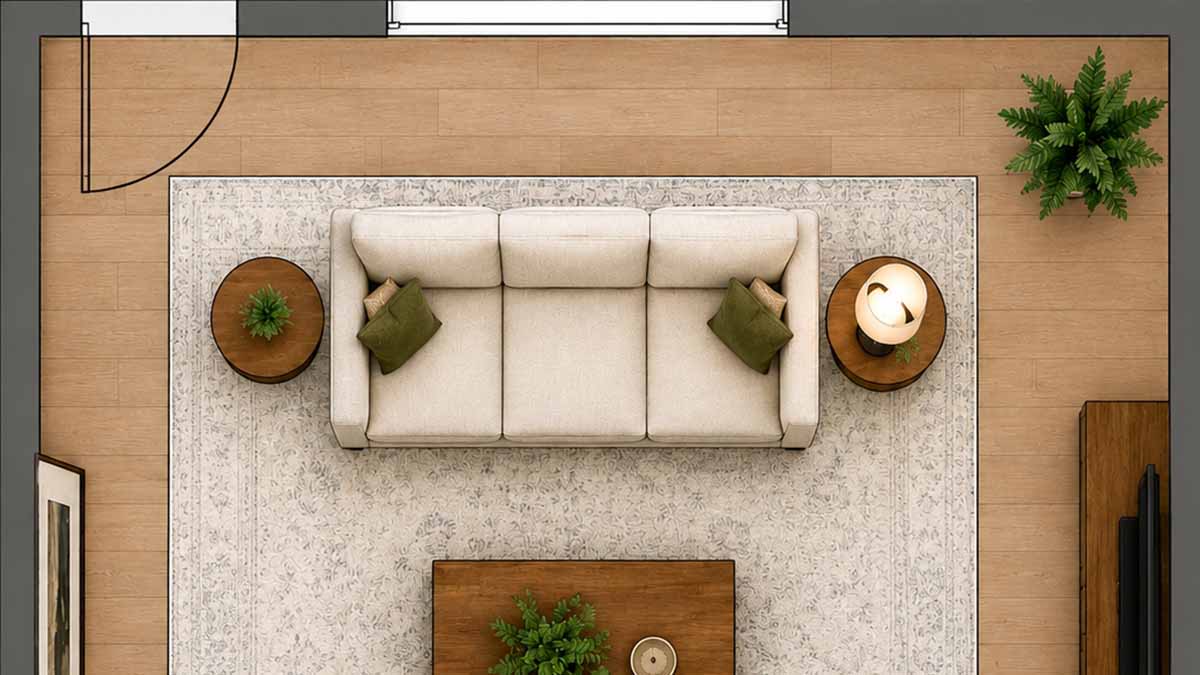
The size of your rug is usually determined by the layout of the room and the furniture in it. One common approach is to place just the front legs of your seating on the rug — this works well in most living rooms and gives the space a pulled-together feel without needing a massive rug. If you have a very open floor plan and want to define your seating area more clearly, you may want to go big enough for all four legs of every piece to sit fully on the rug. Just keep in mind that a bigger rug means a bigger price tag, so we always try to find the smallest size that still looks intentional and works with the layout.
There are no hard and fast rules here. Your sofa might sit fully on the rug while your chairs only have their front legs on it, or the other way around. Just make sure nothing is wobbly from being half on and half off — and if you have swivel chairs, all four legs need to be on the rug, or you’ll swivel yourself right into trouble.
A 9×11 is a good starting point for most living rooms, but the right size always depends on your specific furniture.
Dining Rooms
The dining room has one non-negotiable rule: the rug needs to be large enough for all four legs of the table and every chair to sit on it fully — and still leave enough room for the chairs to slide in and out comfortably. If that sounds like a lot of rug, it is. An 8×10 works for a standard dining table, but if your table has a leaf, go up to a 9×11.
For pile height, I always recommend something low. A thick pile rug under a dining table feels like you’re trying to push through sand every time you get up — especially after a couple of glasses of wine.
In most cases you’ll center the table under the chandelier and the rug under both. That said, personal preference plays a role. If keeping a clear walkway matters more to you than perfect symmetry, it’s fine to shift things slightly — just make sure there’s still enough rug behind each chair for it to slide back comfortably.
Bedrooms
In the bedroom, the rug typically lives under the bed. For a king bed with two nightstands, a 9×12 is usually the right call, with the rug tucking under all the feet. If you have a small sofa or a pair of chairs at the foot of the bed, you can slide that same size rug forward so it starts just in front of the nightstands and extends past the seating — it anchors everything nicely.
If you want to skip the nightstands altogether and don’t have anything at the foot of the bed, you can drop down to a 6×9. Just make sure when you place it, you’re actually stepping out of bed onto the rug in the morning. That’s the whole point.
Large or Unusually Shaped Rooms
For a really large room, or one with a bay window, niche, or irregular shape, consider what designers call the room border approach — leaving roughly 12 to 18 inches of bare floor between the rug edges and the walls. This is where you choose a quality carpet and have it custom bound to fit the room’s exact dimensions and shape. It’s a beautiful solution when nothing off the shelf is going to work.
Rug sizing is one of those things that’s much easier to get right when you’re planning the whole room at once rather than trying to work backward after everything is already in place. If you’d like some help figuring it out, give us a call at 215.837.5060.

Related Posts